Development
Narcotics Anonymous sprang from the Alcoholics Anonymous Program of
the late 1940s, with meetings first emerging in the Los Angeles area of
California, USA, in the early Fifties. The NA program started as a small
US movement that has grown into one of the world's oldest and largest
organizations of its type.
For many years, NA grew very slowly, spreading from Los Angeles to
other major North American cities and Australia in the early 1970s. In
1983, Narcotics Anonymous published its self-titled Basic Text book,
which contributed to tremendous growth. Within a few years, groups had
formed in Brazil, Colombia, Germany, India, the Irish Republic, Japan,
New Zealand, and the United Kingdom.
Today, Narcotics Anonymous is well established throughout much of the
Americas, Western Europe, Australia, and New Zealand. Newly formed
groups and NA communities are now scattered throughout the Indian
subcontinent, Africa, East Asia, the Middle East, and Eastern Europe.
Narcotics Anonymous books and information pamphlets are currently
available in 34 languages, with translations in process for 16
languages.
Return to top
Program
NA's earliest self-titled pamphlet, known among members as "the
White Booklet," describes Narcotics Anonymous this way:
"NA is a nonprofit fellowship or society of men and women for
whom drugs had become a major problem. We … meet regularly to help
each other stay clean. ... We are not interested in what or how much
you used ... but only in what you want to do about your problem and
how we can help."
Membership is open to all drug addicts, regardless of the particular
drug or combination of drugs used. When adapting AA’s First Step, the
word “addiction” was substituted for “alcohol,” thus removing
drug-specific language and reflecting the “disease concept” of
addiction.
There are no social, religious, economic, racial, ethnic, national,
gender, or class-status membership restrictions. There are no dues or
fees for membership; while most members regularly contribute small sums
to help cover the expenses of meetings, such contributions are not
mandatory.
Narcotics Anonymous provides a recovery process and support network
inextricably linked together. One of the keys to NA’s success is the
therapeutic value of addicts working with other addicts. Members share
their successes and challenges in overcoming active addiction and living
drug-free productive lives through the application of the principles
contained within the Twelve Steps and Twelve Traditions of NA. These
principles are the core of the Narcotics Anonymous recovery program.
Principles incorporated within the steps include:
-
admitting there is a problem;
-
seeking help;
-
engaging in a thorough self-examination;
-
confidential self-disclosure;
-
making amends for harm done; and
-
helping other drug addicts who want to recover.
Central to the Narcotics Anonymous program is its emphasis on
practicing spiritual principles. Narcotics Anonymous itself is
non-religious, and each member is encouraged to cultivate an individual
understanding—religious or not—of this “spiritual awakening.”
Narcotics Anonymous is not affiliated with other organizations,
including other twelve step programs, treatment centers, or correctional
facilities. As an organization, NA does not employ professional
counselors or therapists nor does it provide residential facilities or
clinics. Additionally, the fellowship does not provide vocational,
legal, financial, psychiatric, or medical services. NA has only one
mission: to provide an environment in which addicts can help one another
stop using drugs and find a new way to live.
In Narcotics Anonymous, members are encouraged to comply with
complete abstinence from all drugs including alcohol. It has been the
experience of NA members that complete and continuous abstinence
provides the best foundation for recovery and personal growth. NA as a
whole has no opinion on outside issues, including prescribed
medications. Use of psychiatric medication and other medically indicated
drugs prescribed by a physician and taken under medical supervision is
not seen as compromising a person’s recovery in NA.
Return to top
Service organization
The primary service provided by Narcotics Anonymous is the NA group
meeting. Each group runs itself based on principles common to the entire
organization, which is spelled out in NA’s literature.
Most groups rent space for their weekly meetings in buildings run by
public, religious, or civic organizations. Individual members lead the
NA meetings while other members take part by sharing in turn about their
experiences in recovering from drug addition. Group members also share
the activities associated with running a meeting.
In a country where Narcotics Anonymous is a relatively new
phenomenon, the NA group is the only level of organization. In places
where a number of Narcotics Anonymous groups have had the chance to
develop and stabilize, groups will have elected delegates to form a
local service committee. These local committees usually offer a number
of services. Included among them are:
-
distribution of NA literature;
-
telephone information services;
-
presentations for treatment staff, civic organizations,
government agencies, and schools;
-
presentations to acquaint treatment or correctional facility
residents with the NA program; and
-
meeting directories for individual information and use in
scheduling visits by client groups.
In some countries, especially the larger countries or those where
Narcotics Anonymous is well established, a number of local/area
committees have come together to create regional committees. These
regional committees handle services within their larger geographical
boundaries while the local/area committees handle local services.
An international delegate assembly known as the World Service
Conference provides guidance on issues affecting the entire
organization. Primary among the priorities of NA’s world services are
activities that support young national movements and the translation of
Narcotics Anonymous literature. For additional information, contact the
World Service Office headquarters in Los Angeles, California. The
mailing address, telephone number, fax number, and website address
appear at the end of this pamphlet.
Return to top
Positions on related issues or institutions
In order to maintain its focus, Narcotics Anonymous has established a
tradition of non-endorsement and does not take positions on anything
outside its own specific sphere of activity. Narcotics Anonymous does
not express opinions—either pro or con—on civil, social, medical,
legal, or religious issues. Additionally, it does not take stands on
addiction-related issues such as criminality, law enforcement, drug
legalization or penalties, prostitution, HIV/HCV infection, or syringe
programs.
Narcotics Anonymous is entirely self-supporting and does not accept
financial contributions from non-members. Based on the same principle,
groups and service committees are run by NA members, for members.
Narcotics Anonymous neither endorses nor opposes any other
organization’s philosophy or methodology. Its primary competence is in
providing a platform upon which drug addicts can share their recovery
and experiences with one another. This is not to say that Narcotics
Anonymous believes there are not any other “good” or “worthy”
organizations. To remain free of the distraction of controversy, NA
focuses all of its energy on its particular area of purpose, leaving
other organizations to fulfill their own goals.
Return to top
Cooperating with Narcotics Anonymous
Although certain traditions guide its relations with other
organizations, Narcotics Anonymous welcomes the cooperation of those in
government, the clergy, the helping professions, and private voluntary
organizations. NA’s nonaddict friends have been instrumental in
getting Narcotics Anonymous started in many countries and helping NA
grow.
NA strives to cooperate with others interested in Narcotics Anonymous
by providing contact information, literature, and information about
recovery through the NA Fellowship. Additionally, NA members are often
available to make panel presentations in treatment centers and
correctional facilities, sharing the NA program with addicts otherwise
unable to attend community-based meetings.
Return to top
Membership demographics
To offer some general informal observations about the nature of the
membership and the effectiveness of the program the following
observations are believed to be reasonably accurate.
The socioeconomic strata represented by the NA membership vary from
country to country. Members of one particular social or economic class
start most national NA movements, but as their outreach activities
become more effective, the membership becomes more broadly
representative of all socioeconomic backgrounds.
All ethnic and religious backgrounds are represented among NA
members. Once a national movement reaches a certain level of maturity,
its membership generally reflects the diversity or homogeneity of the
background culture.
Membership in Narcotics Anonymous is voluntary; no attendance records
are kept either for NA’s own purposes or for others. Because of this,
it is sometimes difficult to provide interested parties with
comprehensive information about NA membership. There are, however, some
objective measures that can be shared based on data obtained from
members attending one of our world conventions; the diversity of our
membership, especially ethnic background, seems to be representative of
the geographic location of the survey. The following demographic
information was revealed in a survey returned by almost half of the
13,000 attendees at the 2003 NA World Convention held in San Diego,
California:
-
Gender: 55% male, 45% female.
-
Age: 3% 20 years old and under, 12% 21–30 years old, 31%
31–40 years old, 40% 41–50 years old, 13% over age 51, and 1%
did not answer.
-
Ethnicity: 70% Caucasian, 11% African-American, 11% Hispanic, and
8% other.
-
Employment status: 72% employed full-time, 9% employed part-time,
7% unemployed, 3% retired, 3% homemakers, 5% students, and 1% did
not answer.
-
Continuous abstinence/recovery: ranged from less than one year up
to 40 years, with a mean average of 7.4 years.
Return to top
Rate of growth
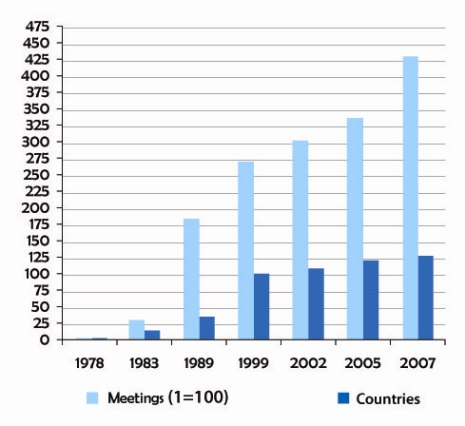
Because no attendance records are kept, it is impossible
to estimate what percentages of those who come to Narcotics Anonymous
remain active in NA over time. The only sure indicator of the program's
success is the rapid growth in the number of registered Narcotics
Anonymous meetings in recent decades and the rapid spread of Narcotics
Anonymous outside North America.
-
In 1978, there were fewer than 200 registered groups in three
countries.
-
In 1983, more than a dozen countries had 2,966 meetings.
-
In 1993, 60 countries had over 13,000 groups holding over 19,000
meetings.
-
In 2002, 108 countries had 20,000 groups holding over 30,000
meetings.
-
In 2005, 116 countries had over 21,500 groups holding over 33,500
weekly meetings.
-
In 2007, there are over 25,065 groups holding over 43,900 weekly
meetings in 127 countries.
|